
Quick answer
What to know first
OSHA’s bloodborne-pathogens standard addresses occupational exposure to blood and other potentially infectious materials; it is a workplace-safety framework, not a substitute for site-specific assessment.
What to do next: For a cleanup situation, use the standard to ask informed questions about training, PPE, controls, and documentation. Explore the related service.
Official guidance: OSHA bloodborne-pathogen standard · EPA disinfectant guidance
Biohazard cleanup in Texas is governed by federal OSHA standards, EPA regulations, and Texas TCEQ rules. The primary federal standard is 29 CFR 1910.1030 — the Blood-Borne Pathogen (BBP) Standard. Property owners who hire non-compliant contractors can face liability for worker injuries. This guide covers what the law requires and how to protect yourself.
01Why OSHA Standards Matter to Property Owners
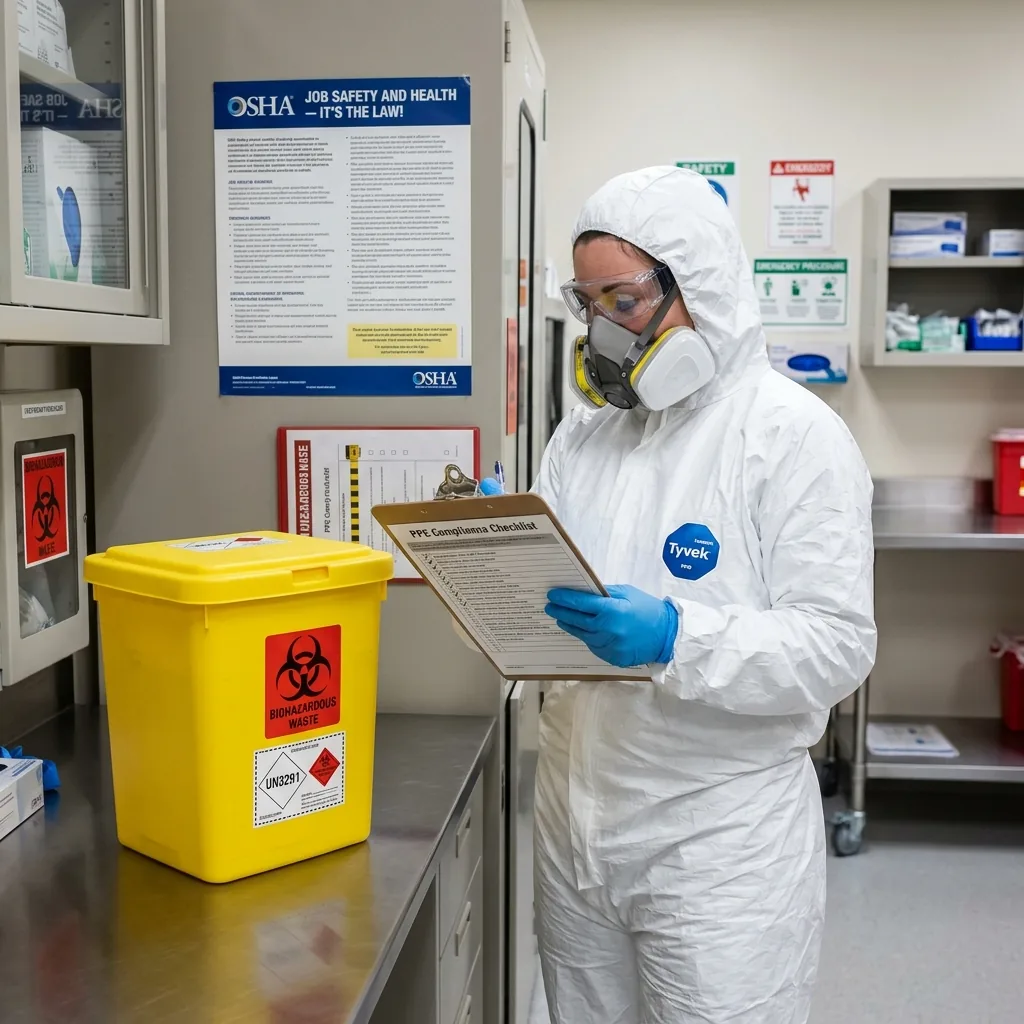
Most property owners assume that OSHA regulations only apply to the cleanup company — not to them. This is partially true, but not entirely. Under OSHA's Multi-Employer Worksite Policy, a property owner who directs or controls the work of contractors on their property may share OSHA liability for violations that occur on their premises, particularly if they direct non-certified workers to perform biohazard cleanup without proper training and PPE.
More practically: hiring a non-compliant company exposes you to three risks: (1) workers who are inadequately protected may make exposure claims against your property, (2) non-licensed waste disposal exposes you to TCEQ fines, and (3) inadequate decontamination creates ongoing liability if future occupants suffer health effects.
02Primary OSHA Standards for Biohazard Cleanup
| OSHA Standard | What It Covers | Key Requirement |
|---|---|---|
| 29 CFR 1910.1030 Blood-Borne Pathogen Standard | All work involving potential exposure to blood or OPIM (other potentially infectious materials) | Written Exposure Control Plan, Universal Precautions, PPE, HBV vaccination, post-exposure protocol |
| 29 CFR 1910.132 PPE General Requirements | Selection, provision, and training on personal protective equipment | Employer must assess hazards and provide appropriate PPE at no cost to workers |
| 29 CFR 1910.134 Respiratory Protection | Selection and use of respirators in work environments with airborne hazards | Written respiratory protection program; fit testing for all respirator users; NIOSH-approved equipment only |
| 29 CFR 1910.120 HAZWOPER Standard | Hazardous waste operations and emergency response | 40-hour training + 8-hour annual refresher for technicians at hazardous waste sites |
| 29 CFR 1910.1200 Hazard Communication | Chemical hazards communication (GHS system) | Safety Data Sheets (SDS) for all chemicals used; employee training on chemical hazards |
| EPA 40 CFR 259/261 Medical Waste Regulations | Generation, storage, transport, and disposal of regulated medical/biohazardous waste | Proper containerization, labeling, manifesting, and disposal at licensed facilities |
03OSHA PPE Requirements for Biohazard Cleanup
OSHA 29 CFR 1910.1030 and 1910.132 require specific PPE for biohazard cleanup based on the hazard level. Here is the PPE hierarchy from standard blood cleanup to extreme situations:
Level C (Standard Blood Cleanup)
Tyvek coveralls with hood, double nitrile gloves, N95 particulate respirator, face shield, shoe covers. Required for all blood-borne pathogen cleanup. This is the minimum required PPE under OSHA 1910.1030 for biohazard technicians.
Level B (Decomposition / Advanced Biohazard)
Encapsulated Tyvek suit, double nitrile gloves + outer chemical-resistant gloves, supplied-air respirator (SAR) or powered air-purifying respirator (PAPR), full-face shield. Required for advanced decomposition, meth lab residue, or unknown chemical hazard situations.
Level A (Extreme Chemical / Unknown Hazard)
Fully encapsulated vapor-tight chemical protective suit, self-contained breathing apparatus (SCBA), inner and outer chemical-resistant gloves, steel-toe chemical-resistant boots. Required for unknown chemical hazards, methamphetamine production situations with undetermined chemicals, or situations involving potential airborne infectious agents.
04Decontamination Requirements Under OSHA 1910.1030
05OSHA and TCEQ Waste Disposal Requirements
Proper Containerization
All biohazardous waste must be placed in red biohazard bags (ASTM D1709 puncture resistant), sealed, then placed in rigid DOT-approved biohazard containers. Sharps must go in rigid sharps containers before being placed in biohazard bags. No exceptions.
Proper Labeling
All biohazard containers must be labeled with the universal biohazard symbol and the word "BIOHAZARD." Labels must be fluorescent orange-red. Proper labeling is required from the moment materials are bagged at the site until disposal at the licensed facility.
Licensed Transport Only
Texas TCEQ requires biohazardous waste to be transported by vehicles and drivers licensed specifically for medical/biohazardous waste transport. Our vehicles carry current TCEQ licenses. We can provide license verification numbers before work begins.
Chain-of-Custody Manifest
A complete chain-of-custody manifest documenting the waste generator (property address), hauler ID, waste type and volume, and receiving facility must accompany every shipment. We provide complete manifests as part of our documentation package for your records and insurance claim.
06OSHA Fines and Penalties (2025)
| Violation Type | Maximum Penalty (2025) | Common Biohazard Violations |
|---|---|---|
| Serious Violation | $15,625 per violation | No written Exposure Control Plan; no HBV vaccination offered; inadequate PPE; no BBP training records |
| Willful Violation | $156,259 per violation | Knowing failure to provide required PPE; ignoring previous OSHA citation; directing workers into hazardous areas without protection |
| Repeat Violation | $156,259 per violation | Same violation cited within 3 years of initial citation |
| Other-Than-Serious | $15,625 per violation | Missing training records; SDS sheets not accessible; improper labeling (non-critical) |
| Failure to Abate | $15,625 per day | Failure to correct previously cited violation within OSHA-specified abatement period |
07How to Verify a Biohazard Company Is OSHA Compliant
Before hiring any biohazard cleanup company in Fort Worth or anywhere in Texas, ask these specific questions. Legitimate, compliant companies answer all of them without hesitation:
We exceed all OSHA requirements. Our team holds OSHA 40-hour HAZWOPER certification, annual BBP training, TCEQ biohazardous waste transport licensing, and BIOHAZARD certification. We provide all compliance documentation before, during, and after every job. Contact us to verify our credentials.
OSHA-Certified Biohazard Cleanup — Fort Worth
Full documentation. Written clearance certificates. Direct insurance billing. Available 24/7.
Frequently Asked Questions
OSHA biohazard cleanup standards explained by Fort Worth certified professionals
The primary OSHA standard is 29 CFR 1910.1030 (Blood-Borne Pathogen Standard). Additional standards include 29 CFR 1910.132 (PPE requirements), 29 CFR 1910.134 (Respiratory Protection), and 29 CFR 1910.120 (HAZWOPER) for hazardous waste operations. All certified biohazard cleanup companies in Texas must comply with all applicable standards simultaneously.
OSHA serious violations carry penalties up to $15,625 per violation in 2025. Willful or repeated violations can reach $156,259 per violation. Common violations in biohazard cleanup include: no written Exposure Control Plan, failure to offer HBV vaccination, inadequate PPE, missing annual BBP training records, and improper waste disposal. Property owners who direct non-certified workers into biohazard situations may also face OSHA liability.
Ask for: (1) their written OSHA 1910.1030 Exposure Control Plan, (2) evidence of annual BBP training for all technicians, (3) their TCEQ biohazardous waste transport license number, (4) HAZWOPER certification cards for their lead technicians, and (5) documentation showing they use EPA List Q registered disinfectants. We provide all of this documentation upon request before starting any job.