
Quick answer
What to know first
A biohazard inspection identifies affected materials, safe work zones, access needs, and the cleanup scope before remediation begins.
What to do next: The first call should establish whether the scene is released and who can authorize access to the property. Explore the related service.
Official guidance: OSHA bloodborne-pathogen standard · EPA disinfectant guidance
A professional biohazard inspection does two things that no other assessment can: it reveals contamination that is completely invisible to the naked eye under normal lighting, and it provides legally defensible documentation of contamination scope for insurance, legal, and property transaction purposes. A thorough inspection is always the starting point — never the end point — of any biohazard situation.
01What Is a Professional Biohazard Inspection?
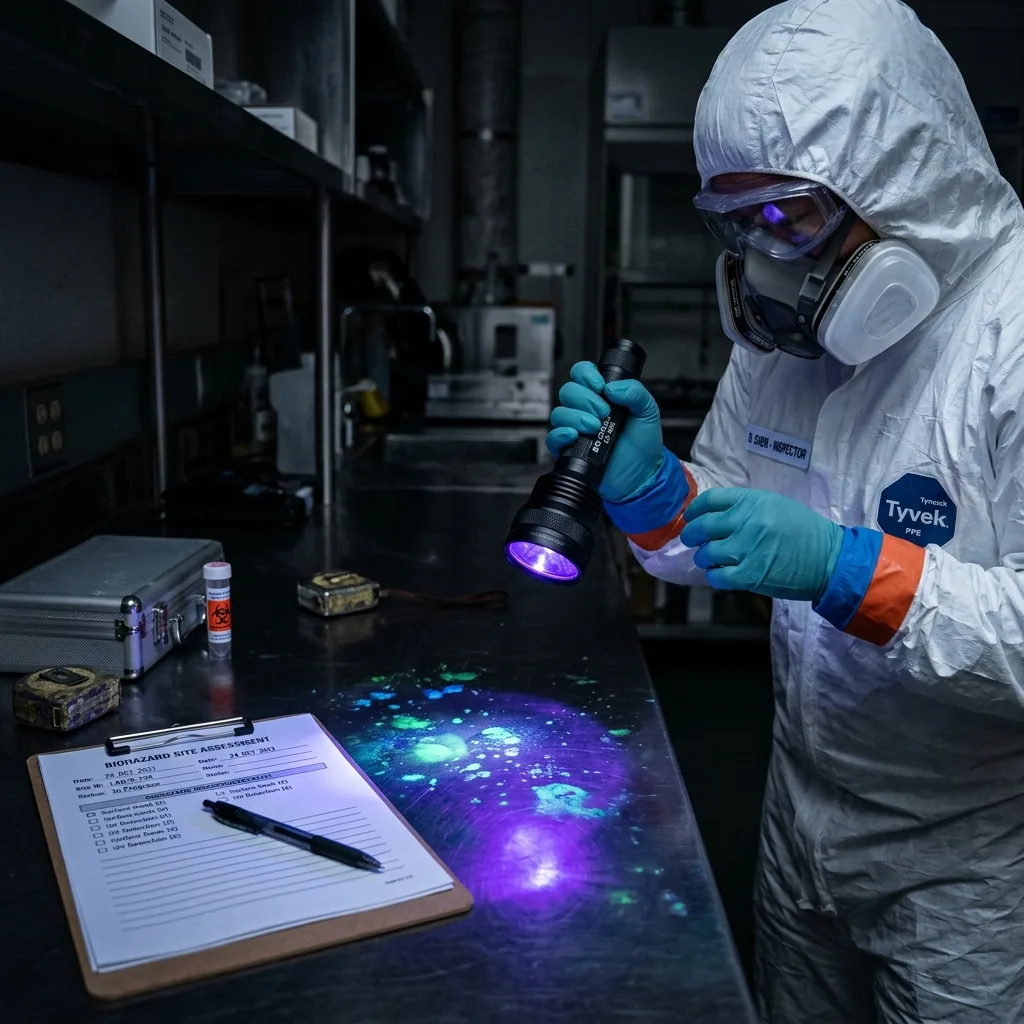
A professional biohazard inspection is a systematic assessment of a property to identify, map, and document all biological contamination present. It is fundamentally different from a visual inspection because biohazard contamination is largely invisible under normal lighting — blood at low concentrations, decomposition satellite spatter, and dried biological material require specialized equipment to detect.
Our Fort Worth inspections are performed by OSHA HAZWOPER-certified technicians using industry-standard forensic equipment. Every inspection is fully documented and results in a written scope-of-work assessment that forms the basis of your estimate and your insurance claim.
02UV Forensic Mapping: Revealing the Invisible
UV (ultraviolet) forensic inspection is the cornerstone of biohazard assessment. High-intensity UV-A and UV-C light sources cause biological materials to fluoresce, revealing contamination invisible under normal white light. This is the same technology used by law enforcement crime scene investigators.
What UV Light Reveals
Blood (fresh and dried), decomposition fluids, urine and fecal matter, seminal fluid, saliva, and most other biological materials fluoresce distinctly under UV examination. Each biological material has characteristic fluorescence patterns that experienced technicians can interpret to determine contamination type, approximate age, and likely source location.
Spatter Pattern Analysis
Bloodstain pattern analysis using UV mapping reveals the directionality, velocity, and mechanism of blood distribution. This information is critical for defining the full scope of contamination — satellite spatter from a high-velocity event can deposit biological material on ceiling tiles, inside ventilation grilles, and behind wall-mounted fixtures that would never be checked without UV mapping.
Photographic Documentation
All UV fluorescence findings are photographed with calibrated UV photography equipment. These photographs become part of the formal contamination documentation package — essential for insurance adjusters, and required for any subsequent legal proceedings. Photographs are taken before any cleaning begins.
Contamination Zone Mapping
UV findings are transferred to a spatial contamination map of the property — a room-by-room diagram showing all contaminated zones, their extent, and contamination levels. This map guides the cleanup plan, defines material removal scope, and provides a reference point for post-cleanup clearance testing locations.
03ATP Bioluminescence Testing: Scientific Verification
ATP (adenosine triphosphate) bioluminescence testing provides objective, quantifiable measurement of organic contamination at any surface location. ATP is present in all living cells — every blood cell, every bacterium, every biological particle. The test uses a luminometer device that measures the light emitted when ATP reacts with luciferin-luciferase reagent.
| ATP Reading (RLU) | Interpretation | Action Required |
|---|---|---|
| < 100 RLU | PASS — Surface is microbiologically clean | Clearance certificate issued for this location |
| 100–300 RLU | BORDERLINE — Additional treatment recommended | Additional disinfection pass; retest before clearance |
| 300–1,000 RLU | FAIL — Significant organic contamination present | Full retreatment; structural material removal likely needed |
| > 1,000 RLU | FAIL — Heavy contamination; gross organic matter present | Structural removal required; root-cause investigation |
Why ATP testing matters for you: ATP testing is the only way to scientifically confirm that decontamination was successful. A surface that looks clean may read 50,000+ RLU on ATP testing. Without documented ATP test results, you have no proof that contamination was eliminated — which creates problems for insurance claims, property sales, and future occupant liability.
04Air Quality Monitoring During Inspection
For situations involving decomposition, meth lab residue, mold, or sewage, air quality monitoring is conducted alongside the surface inspection. Air quality assessment tools used in biohazard inspections include:
05Step-by-Step: What Happens During Our Inspection
Pre-Entry Assessment and PPE Donning
Before entering the property, our lead technician reviews the situation with you outside the contaminated area, asks about the event timeline, any known medical history of persons involved (for pathogen risk assessment), and the property layout. PPE appropriate to the situation is then donned following OSHA protocols before any entry.
Primary Contamination Zone Entry and Assessment
The primary contaminated area is entered and assessed visually under white light first, then under UV forensic lighting. All visible contamination is catalogued. UV fluorescent areas are photographed and mapped. The floor, walls, ceiling, furniture, and all surfaces within the radius of potential spatter are systematically checked.
Adjacent Area Assessment
All areas adjacent to the primary zone are assessed — hallways, adjacent rooms, HVAC intake registers, and any surface that may have received satellite spatter or contaminated foot traffic. Adjacent area contamination is commonly missed by untrained assessors and becomes a liability source if not addressed.
Material Penetration Assessment
Contaminated materials are assessed for the depth of penetration using probes and moisture meters where appropriate. This determines which materials can be decontaminated in place and which must be physically removed. The material assessment is the primary determinant of cleanup cost and is documented in your estimate with explicit justification for every removal recommendation.
HVAC and Structural Assessment
HVAC return vents, ductwork accessible points, and the air handler are inspected for contamination. Structural elements including wall cavities (by probe), subflooring, insulation, and concrete are assessed for penetration. This assessment determines odor elimination requirements and HVAC decontamination scope.
Air Quality Sampling
VOC readings and particulate counts are taken at multiple points in the primary zone and adjacent areas. For decomposition situations, this data directly informs the odor elimination protocol scope. Readings are documented for the inspection report.
Scope-of-Work Assessment and Written Estimate
All inspection findings are compiled into a written scope-of-work document that itemizes: contaminated zones, materials requiring removal, surfaces requiring decontamination, odor elimination requirements, HVAC decontamination scope, estimated labor hours, materials cost, and disposal fees. This is provided to you before any authorization is requested.
06Documents You Receive From the Inspection
07Post-Cleanup Clearance Testing: The Final Verification
After all cleanup work is complete, a formal clearance inspection is conducted using the same UV forensic and ATP testing equipment. The clearance inspection verifies:
Upon passing all clearance criteria, we issue a formal written Biohazard Clearance Certificate that includes: all ATP test results with GPS-tagged location data, before/after UV photographs, air quality data, technician OSHA certification numbers, and our company's TCEQ license number. This certificate provides permanent, legally defensible documentation that the property was professionally decontaminated.
Our inspections are free for Fort Worth and DFW clients. We provide the complete pre-inspection assessment, contamination mapping, UV forensic documentation, and written scope of work at no charge. You only pay if you authorize the cleanup work. Call +1 (817) 547-0217 to schedule a free on-site inspection now.
Free Biohazard Inspection — Fort Worth & DFW
UV forensic mapping. ATP testing. Written scope of work. No obligation. 24/7 availability.
Frequently Asked Questions
Biohazard inspection process questions answered by Fort Worth professionals
A professional biohazard inspection includes: (1) UV forensic lighting scan to reveal all contamination invisible to the naked eye, (2) photographic documentation of all findings, (3) contamination mapping room by room, (4) material penetration assessment to determine what can be decontaminated vs. removed, (5) HVAC and adjacent area assessment, (6) air quality sampling, and (7) written scope-of-work estimate with itemized costs. Our Fort Worth inspections are free with no obligation.
UV forensic inspection uses high-intensity ultraviolet light to reveal biological contamination — blood, decomposition fluids, urine — that is completely invisible under normal white light. Blood spatter from violent events can travel 8–12 feet from the source and deposits on ceilings, walls, and hidden surfaces that would never be checked without UV equipment. UV mapping defines the true scope of contamination before any cleaning begins, ensuring nothing is missed and providing photographic documentation for insurance.
ATP (adenosine triphosphate) bioluminescence testing measures organic contamination using a luminometer device. ATP is present in all living cells — blood, bacteria, biological material. Post-cleanup readings below 100 RLU (relative light units) scientifically confirm successful decontamination. ATP testing is the industry standard for biohazard clearance verification and is required by our BIOHAZARD certification. Results are documented and included in your clearance certificate.
A standard residential biohazard inspection in Fort Worth takes 1–3 hours depending on property size and situation complexity. A single-room blood cleanup assessment may take 45–60 minutes. A full unattended death inspection requiring multi-room UV mapping, HVAC assessment, and air quality sampling may take 2–4 hours. The inspection timeline does not affect your cost — inspections are free for all Fort Worth and DFW clients regardless of scope.