
Quick answer
What to know first
Biohazard cleanup pricing depends on the affected materials, contamination depth, access, and disposal requirements; a written on-site scope is more reliable than a phone-only estimate.
What to do next: Ask for a documented scope and contact your insurer before authorizing work when insurance may apply. Explore the related service.
Official guidance: OSHA bloodborne-pathogen standard · EPA disinfectant guidance
Biohazard cleanup costs in Texas range from $500 for minor surface blood cleanup to $40,000+ for extreme hoarding or advanced decomposition. Unlike standard cleaning, biohazard remediation requires OSHA-certified technicians, EPA-registered disinfectants, specialized equipment, and licensed biohazardous waste disposal under Texas and federal law.
01Why Biohazard Cleanup Costs Vary So Much
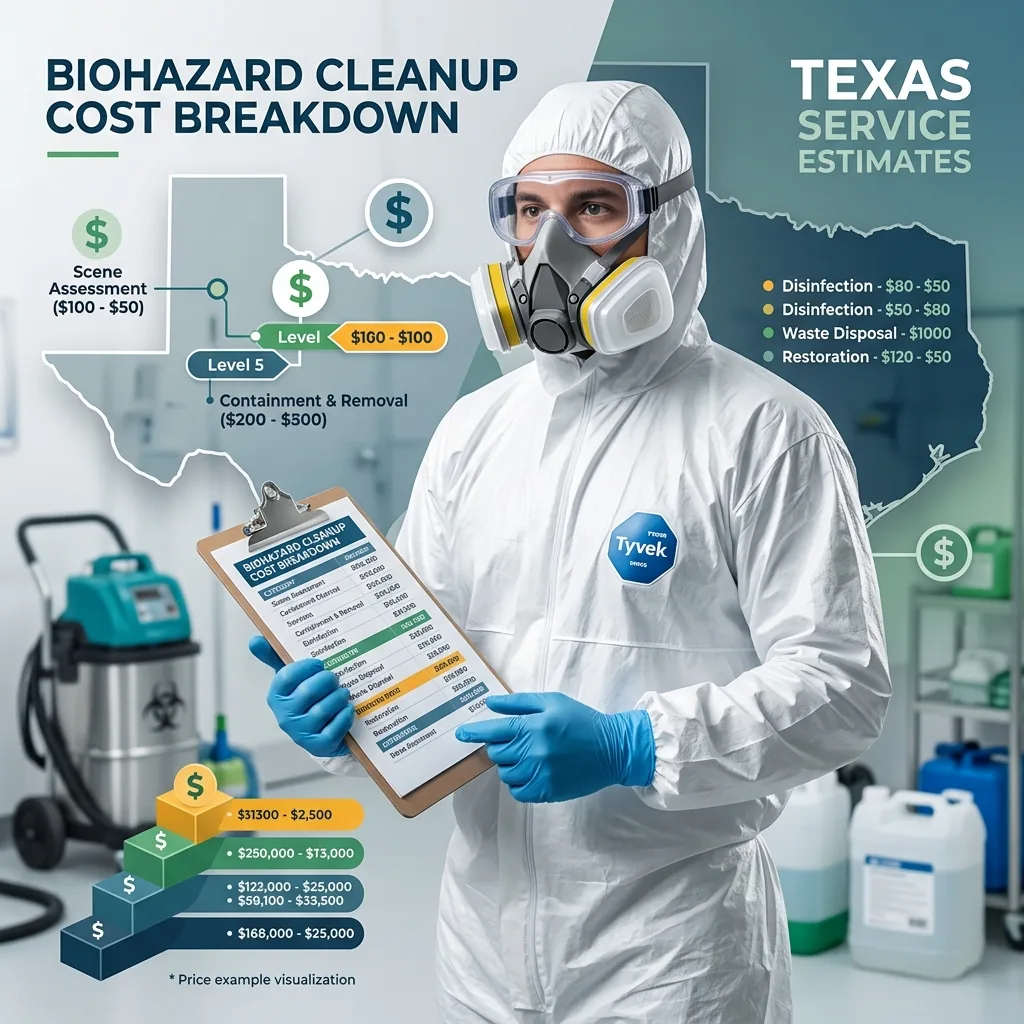
Biohazard cleanup is not a commodity service with fixed pricing. Unlike carpet cleaning or window washing, no two biohazard situations are identical. Cost is determined by a complex combination of contamination type, scene severity, affected area size, depth of penetration into porous materials, and time-sensitive factors unique to Texas's climate.
The most important thing to understand: what you see on the surface is rarely the full scope of contamination. Blood that penetrates carpet padding reaches subflooring within 30 minutes at room temperature. Decomposition fluids can saturate concrete and travel through wall cavities. Accurate pricing requires an on-site assessment — not a phone estimate.
02Biohazard Cleanup Cost by Type (2025 Texas)
Below are realistic 2025 market rates for the Fort Worth / DFW metro area. These represent the full range — simpler cases fall at the lower end, complex multi-room situations with structural material removal fall at the higher end.
| Cleanup Type | Typical Range (Texas 2025) | What Drives Cost |
|---|---|---|
| Surface blood cleanup (small area) | $500 – $2,000 | Surface type, square footage |
| Blood cleanup with porous material removal | $2,000 – $8,000 | Carpet, padding, subfloor removal |
| Crime scene — single room, moderate | $2,000 – $8,000 | UV mapping, full protocol |
| Crime scene — multi-room or extensive | $6,000 – $25,000 | Structural removal, odor elimination |
| Unattended death — within 48 hours | $1,500 – $3,500 | Limited porous penetration |
| Unattended death — 3 to 7 days | $3,000 – $8,000 | Carpet and padding removal likely |
| Unattended death — 1 to 3 weeks | $6,000 – $18,000 | Subflooring and drywall removal |
| Unattended death — advanced (1+ months) | $12,000 – $35,000+ | Structural remediation, concrete treatment |
| Hoarding — Level 1 and 2 | $800 – $3,500 | Deep cleaning, minor biohazard removal |
| Hoarding — Level 3 | $3,000 – $12,000 | Mold, pest, animal waste disposal |
| Hoarding — Level 4 and 5 | $10,000 – $40,000+ | Full structural remediation required |
| Meth lab remediation | $5,000 – $25,000 | Chemical testing, specialized decon |
| Commercial biohazard incident | $1,500 – $20,000 | Rapid response, OSHA documentation |
| Sewage biohazard | $2,000 – $10,000 | Pathogen elimination, structural drying |
Warning about phone estimates: Any company that gives a firm price over the phone without seeing the scene is either overcharging as a safety margin or will add significant charges after starting work. Legitimate biohazard companies provide free on-site assessments before quoting. We always do.
036 Key Factors That Drive Biohazard Cleanup Cost
These six primary variables determine every biohazard estimate. Understanding them helps you evaluate any quote you receive:
1. Type and Volume of Contamination
Blood, decomposition fluid, sewage, meth residue, and animal waste each require different chemicals, PPE levels, and disposal protocols. Decomposition fluid is the most complex — it contains a broad pathogen spectrum and penetrates materials far more aggressively than blood.
2. Square Footage of Affected Area
Technician time, PPE consumption, disinfectant volume, and HEPA air scrubber runtime all scale directly with affected area. Adjacent hallways and rooms where contamination spread must also be treated, not just the primary room.
3. Depth of Penetration into Porous Materials
This is the single largest cost variable. Surface contamination costs $500–$2,000. Contamination saturating carpet padding, subflooring, and concrete can cost 10–20x more because all saturated materials must be physically removed and legally disposed of.
4. Time Elapsed Since the Incident
Every hour allows contamination to penetrate deeper. A scene discovered after one week costs 3–5x more than one discovered within 24 hours. Fort Worth summer heat dramatically accelerates this timeline — see the heat factor section below.
5. Structural Material Removal Required
When contamination penetrates carpet, padding, subflooring, drywall, or insulation beyond the point of chemical decontamination, physical removal is the only safe option. All biohazard-contaminated materials must go to TCEQ-licensed medical waste facilities.
6. PPE Level and Specialized Equipment
Level A PPE (full encapsulation suits, SCBA breathing apparatus) for extreme chemical or decomposition situations is significantly more expensive than Level C (Tyvek coveralls plus N95 respirators) for standard blood cleanup. Industrial HEPA scrubbers, UV forensic mapping systems, and ATP testing all contribute to cost.
04The Fort Worth Heat Factor: Why Texas Costs More
Fort Worth's extreme summer climate — temperatures exceeding 100°F with 60–70% humidity — creates biohazard conditions fundamentally different from northern states. This directly impacts cleanup cost:
Fort Worth summer premium: Summer discoveries (June–September) typically add 20–40% to baseline cost due to accelerated penetration, pest activity, and PPE heat burden. National pricing guides significantly underestimate Texas summer costs. Call us immediately after receiving scene release from the Tarrant County Medical Examiner.
05How Insurance Can Cover 100% of Your Cleanup Cost
Most Fort Worth families are surprised their existing insurance may cover the full cost of biohazard cleanup. Here is how each coverage type works in Texas:
| Coverage Type | What It Covers | Typical Limits | How We Help |
|---|---|---|---|
| Homeowner's (HO-3/HO-5) | Sudden accidental death, crime scenes, unattended death on property | Dwelling coverage limit | Direct billing, all adjuster documentation |
| Renter's Insurance | Biohazard events in a rented property | Personal property plus liability limits | Full documentation package for claim |
| Landlord / Property Insurance | Tenant death scenes, commercial incidents | Property value-based | Property manager billing, rapid response |
| Texas Crime Victims' Compensation | Crime-related cleanup (assault, homicide, any criminal act) | Up to $50,000 per incident | CVC application preparation, required docs |
| Workers' Comp / General Liability | Workplace biohazard incidents | Policy-specific | OSHA documentation, employer liability records |
We bill insurance directly. Our team handles all documentation: itemized invoices, scope-of-work reports, photos, and disposal manifests — everything your adjuster needs. Most clients pay only their deductible ($0–$500 out-of-pocket). Contact us to discuss your situation.
06Hidden Costs to Watch For
Vague Scope Expansion After Starting Work
A company that starts at $1,500 and delivers a $12,000 invoice claiming they "discovered more" is a serious red flag. Request a written estimate that includes exactly what is and is not included — and what happens if additional contamination is found — before authorizing any work.
Unlicensed Waste Disposal
Texas TCEQ law requires biohazardous waste to be transported by licensed haulers to licensed medical waste facilities. Companies that dispose of contaminated materials illegally expose you to fines up to $25,000 per day. Always request disposal manifests showing the receiving facility license number.
No ATP Testing or Clearance Certificate
A company that does not provide ATP bioluminescence testing results and a written clearance certificate has not verified that contamination was fully eliminated. This documentation is essential for insurance claims, property transactions, and legal protection.
Undisclosed Emergency Surcharges
Many companies add 50–100% surcharges for nights, weekends, and holidays without disclosing this upfront. Our pricing is transparent and consistent 24/7. Always ask specifically about after-hours pricing before signing anything.
07How to Get an Accurate Quote in Fort Worth
Get a Free On-Site Estimate — Fort Worth & DFW
Transparent pricing. Written estimates. Direct insurance billing. Available 24/7, 365 days.
Frequently Asked Questions
Biohazard cleanup cost questions answered by Fort Worth OSHA-certified professionals
Texas biohazard cleanup costs range from $500 for minor surface blood cleanup to $40,000+ for extreme hoarding or advanced decomposition. Crime scene cleanup typically runs $1,000–$25,000. Unattended death cleanup ranges $1,500–$35,000+ depending on time elapsed. Most homeowner insurance policies cover the full cost. Call us to discuss your specific situation and insurance options.
Yes — in most cases. Standard HO-3/HO-5 homeowner and renter insurance covers biohazard cleanup for sudden, accidental events. We bill your insurance directly, handle all adjuster communication, and provide the complete documentation package. Most clients pay only their deductible. Texas Crime Victims Compensation covers up to $50,000 for crime-related incidents.
Biohazard cleanup costs reflect genuine required expenses: OSHA-required training and certification, single-use full-body PPE, EPA-registered hospital-grade disinfectants, industrial HEPA air filtration, UV forensic mapping, ATP bioluminescence testing, structural material removal, and licensed biohazardous waste disposal at Texas TCEQ-permitted medical waste facilities. When insurance covers it — which it often does — the cost to you may be nothing more than your deductible.
Fort Worth summer heat above 100°F adds 20–40% to baseline cleanup costs. Blood penetrates carpet padding in 15–20 minutes vs. 30–60 minutes in cooler conditions. Decomposition reaches critical pathogen levels within 24–48 hours vs. 4–7 days. Every hour of delay in Fort Worth summer adds disproportionate cost. Call immediately after receiving scene release from the Tarrant County Medical Examiner.
Hoarding cleanup costs in Texas by ICD level: Level 1–2 (light to moderate clutter) costs $800–$3,500. Level 3 (mold, pests, animal waste — OSHA-certified professionals required) costs $3,000–$12,000. Level 4–5 (severe to extreme with structural damage) costs $10,000–$40,000+. Many homeowner policies cover Level 3–5 cleanup as a property damage claim. We provide free on-site assessments with transparent written estimates.