
Quick answer
What to know first
After law enforcement releases a scene, professional cleanup focuses on containment, removal of affected materials, decontamination, and a documented handoff to the authorized property contact.
What to do next: Confirm scene release and authorized access first; a trained team can then assess the safest next step. Explore the related service.
Official guidance: OSHA bloodborne-pathogen standard · EPA disinfectant guidance
In 2023, Tarrant County reported over 4,200 violent crimes. After every single one, law enforcement processes the scene and leaves — and every trace of biological contamination remains behind. If that contamination is in your property, it is entirely your responsibility.
Most families don't know this until the moment they need to. This guide tells you everything you need to know — who is responsible, what the professional cleanup process involves, how long it takes, what it costs, and how Texas's Crime Victims' Compensation program may cover it all.
01Who Is Responsible for Cleaning a Crime Scene in Texas?
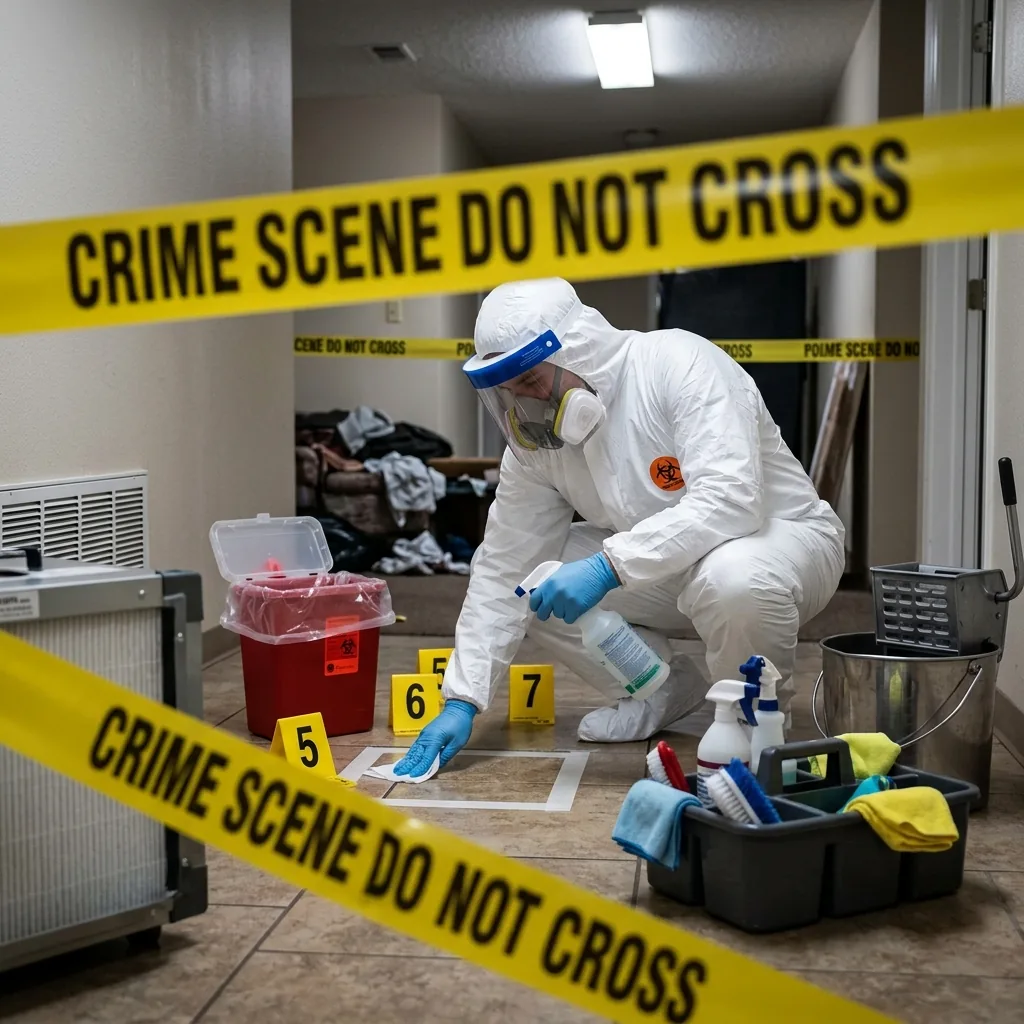
The single most important fact: the Fort Worth Police Department, Tarrant County Sheriff, or any other Texas law enforcement agency does not clean crime scenes. Their job ends when evidence collection is complete.
Once FWPD releases the scene — typically within 24–72 hours — all biological contamination is left exactly where it was found. Cleanup responsibility falls on:
Homeowners
If the incident occurred in your home, you are responsible for cleanup regardless of whether you were involved in the crime. Homeowner's insurance typically covers this.
Landlords & Property Owners
For rental properties, landlords bear cleanup responsibility and must restore the property to habitable condition. They may seek reimbursement from the tenant's estate or insurance.
Estate Executors
When a death occurs, cleanup costs are treated as an estate expense — payable from the deceased's assets before distribution to heirs.
Business Owners
Commercial properties where incidents occur require professional cleanup before employees can legally return to work. OSHA's General Duty Clause mandates a hazard-free workplace.
The FWPD Property Crimes Division provides a scene release letter once evidence collection is complete. Professional cleanup cannot legally begin before receiving this release. You can check release status by calling FWPD's non-emergency line: (817) 392-4222.
02Why DIY Crime Scene Cleanup Is Dangerous & Illegal
Every year, well-meaning family members attempt to handle crime scene cleanup themselves — and every year, some of them end up with serious infections, legal violations, or poorly remediated properties. Here's exactly why DIY is never the right call:
Bloodborne Pathogen Exposure
HIV survives up to 4 days in dried blood on surfaces. Hepatitis B survives 7 days. Hepatitis C survives up to 6 weeks. Contact without proper N95+ respirators and double-layer nitrile gloves is a genuine infection risk.
Aerosolization of Pathogens
Using spray bottles or scrubbing blood with household cleaners creates airborne droplets containing live pathogens — turning a surface hazard into something that can be inhaled directly into your lungs.
Hidden Subsurface Contamination
Blood saturates carpet fibers into padding within seconds. From there it penetrates subflooring, reaches concrete slabs, and can infiltrate wall cavities. What looks clean on the surface can hide weeks of dangerous contamination below.
Federal & Texas Legal Violations
Texas TCEQ regulations classify blood-contaminated materials as biohazardous waste requiring licensed disposal. Placing contaminated materials in regular trash results in fines of up to $25,000 per day per violation.
03The Professional 7-Step Crime Scene Cleanup Process
Every OSHA-certified crime scene cleanup follows a standardized protocol designed to eliminate biological contamination completely — not just make it look clean. Here is every step, explained in detail:
Scene Release & Initial Documentation
Cleanup begins only after law enforcement provides written scene release. Our technicians immediately document the full scope of contamination with photos and detailed notes — critical records for insurance claims, estate proceedings, and Texas CVC applications.
PPE Donning & Site Safety Assessment
All technicians don full-body Tyvek coveralls, N95+ or P100 respirators, double-layer nitrile gloves, and face shields before entering. The structure is assessed for safety risks — electrical, structural, and biological — before active work begins.
Containment & Negative Air Pressure
Polyethylene barrier sheeting seals all openings to adjacent areas. HEPA-filtered negative air pressure machines create directional airflow that traps all particulates and pathogens within the work zone, preventing cross-contamination to unaffected rooms.
UV Mapping & Biological Material Removal
UV forensic lights reveal contamination invisible to the naked eye. All visible and UV-identified biological matter is carefully collected and sealed in DOT-approved biohazard containers. Saturated porous materials — carpet, padding, drywall, wood — that cannot be safely decontaminated are removed entirely.
EPA-Registered Multi-Application Disinfection
All remaining surfaces receive multiple applications of EPA-registered, hospital-grade disinfectants with proven kill claims for HIV, HBV, HCV, and MRSA. Each application is maintained for the required dwell time — not just sprayed and wiped immediately, which is a common DIY failure point.
Industrial Odor Elimination
Industrial enzymatic deodorizers target odor compounds at the molecular level — not covering them, but destroying them chemically. HEPA air scrubbers run continuously. For deep structural odors, ozone or hydroxyl radical treatment is applied with sufficient dwell time for complete remediation.
ATP Testing, Final Inspection & Clearance Certificate
Post-cleanup ATP (adenosine triphosphate) testing verifies that biological contamination has been eliminated to safe levels on all tested surfaces. A written clearance certificate, full scope-of-work documentation, and waste disposal manifests are provided — everything needed for insurance claims, Texas CVC applications, and legal proceedings.
04How Long Does Crime Scene Cleanup Take?
Timeline depends primarily on the size of the affected area and depth of contamination. Fort Worth's hot climate (100°F+ summers) accelerates biological decomposition, making prompt response even more critical:
Fort Worth climate warning: In summer heat above 100°F, biological materials in an enclosed space can reach critical contamination levels within hours. Blood that penetrates carpet padding reaches subflooring within 30 minutes at room temperature. Every hour of delay increases both remediation difficulty and cost.
05Crime Scene Cleanup Costs in Fort Worth (2025)
Crime scene cleanup costs vary significantly based on affected area size, contamination depth, and structural material removal requirements. These are realistic 2025 market ranges for the Fort Worth / DFW area:
| Scenario | Typical Range | Key Variables |
|---|---|---|
| Small blood cleanup — one room, surface contamination | $500 – $2,000 | Surface type, area size |
| Moderate crime scene — 1–2 rooms, some structural removal | $2,000 – $6,000 | Penetration depth, materials |
| Major violent crime — multiple rooms, extensive remediation | $6,000 – $20,000+ | Structural damage, scope |
| Commercial/business property crime scene | $2,500 – $25,000+ | Property size, business type |
Texas Crime Victims' Compensation (CVC) may cover 100% of your costs. If a violent crime occurred, the Texas AG's CVC program provides up to $50,000 for cleanup expenses — regardless of insurance. We handle all CVC documentation. Call us to start the process immediately.
06Insurance & Texas CVC Coverage
Contact the Tarrant County DA's Victim Assistance Division at (817) 884-1400 for help with Texas CVC applications. We prepare all itemized documentation required for successful CVC claims — invoice, scope of work, photos, and disposal manifests.
Frequently Asked Questions
Crime scene cleanup questions answered by Fort Worth OSHA-certified professionals
Ideally within 24 hours of scene release. Delay allows biological materials to penetrate deeper into porous surfaces — carpet, padding, subflooring, concrete — dramatically increasing both health risks and remediation costs. Fort Worth's summer heat accelerates this process significantly. Our team responds within 1–2 hours of your call, 24/7, 365 days a year.
We strongly recommend family members not be present during active cleanup. Our team provides a thorough briefing before and after. Family presence during cleanup creates additional psychological trauma risks and potential safety concerns from biological and chemical hazards. We handle everything professionally so your family doesn't have to witness the process.
Most policies cover crime scene cleanup costs above your deductible (typically $500–$2,500). If the incident was a qualifying violent crime, Texas CVC may cover the deductible too — effectively providing full coverage. We document every expense to maximize your claim. Contact us and we'll help you understand exactly what your policy covers before any work begins.
Ask for: (1) OSHA BBP training certificates for all assigned technicians, (2) Texas DSHS biohazardous waste contractor license, (3) EPA-registered disinfectants list with HIV/HBV kill claims, (4) Proof of general liability and workers' compensation insurance, (5) A written estimate before any work begins. Any reputable company will provide all of these immediately. Companies that pressure you to skip the estimate or sign immediately should be avoided.
Facing a Crime Scene Situation Right Now?
Don't wait -- every hour matters. Our OSHA-certified Fort Worth team responds within 1-2 hours, 24/7. We coordinate with FWPD and handle all Texas CVC documentation.