
Quick answer
What to know first
Blood cleanup requires more than visible-surface cleaning because contamination can reach porous materials and hidden edges.
What to do next: Limit access to the area and arrange a professional assessment instead of attempting to clean without suitable PPE and procedures. Explore the related service.
Official guidance: OSHA bloodborne-pathogen standard · EPA disinfectant guidance
Blood is classified as a potentially infectious material (OPIM) under OSHA's Bloodborne Pathogens Standard (29 CFR 1910.1030) and as biohazardous waste under Texas Health and Safety Code Chapter 361. Professional blood cleanup requires OSHA-certified technicians, EPA-registered disinfectants with specific pathogen kill claims, and licensed biohazardous waste disposal. Consumer cleaning products — including bleach at safe-use concentrations — are scientifically proven ineffective at eliminating bloodborne pathogens from surfaces.
Why Is Blood Dangerous After an Incident?
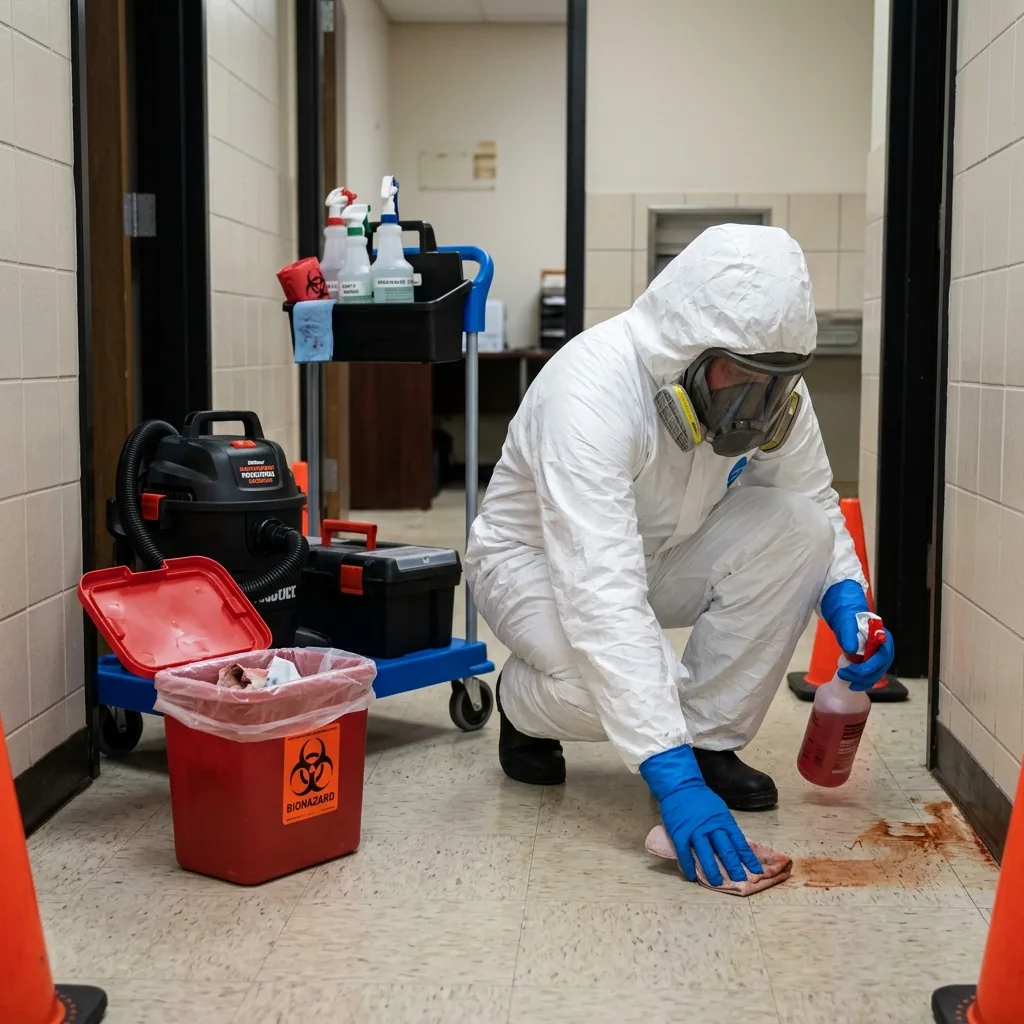
When most people encounter blood from an accident, injury, or crime scene, their instinct is to clean it up quickly with household supplies. This is one of the most dangerous misconceptions in home safety.
Human blood can carry numerous bloodborne pathogens — live viruses, bacteria, and parasites that remain infectious and survive far longer on surfaces than most people realize. The danger isn't just in wet blood. Dried blood on a surface can still be fully infectious for days.
Any blood spill from an unknown source — or from someone with a known or suspected bloodborne infection — requires professional biohazard cleanup. In Fort Worth, TX, call +1 (817) 547-0217 for immediate 24/7 certified response. Even blood from a family member's injury should be cleaned by professionals if it covers a significant area or penetrated porous surfaces.
Bloodborne Pathogen Survival Times: The Data
The survival times of bloodborne pathogens on surfaces are based on peer-reviewed research published by the CDC, NIH, and major infectious disease journals. These are not estimates — they are laboratory-confirmed findings:
| Pathogen | Surface Survival Time | Risk Level | Why Consumer Cleaners Fail |
|---|---|---|---|
| Hepatitis B Virus (HBV) | Up to 7 days | Very High | Requires EPA-registered disinfectants at specific concentrations; household bleach concentration too low at safe use |
| Hepatitis C Virus (HCV) | Up to 4 days | High | Highly resistant to standard cleaners; survives desiccation in dried blood |
| HIV | Up to 4 days (dried blood) | Moderate-High | Invisible in dried blood; requires professional UV mapping plus EPA disinfection |
| MRSA (Staph aureus) | Days to weeks | High | Antibiotic-resistant; requires hospital-grade antimicrobial treatment protocols |
| Clostridium difficile | Months (spores) | Very High | Spores resist standard disinfectants; requires bleach at 1:10 dilution minimum — hazardous without PPE |
Critical Warning: Household bleach at typical cleaning concentrations (1:100 dilution) does NOT meet the EPA kill requirements for bloodborne pathogens. Studies show that even surfaces that appear "bleached clean" retain viable pathogens at this concentration. Only EPA-registered disinfectants applied at their label-specified concentration and dwell time provide scientifically validated pathogen elimination.
5 Specific Reasons Why DIY Blood Cleanup Fails
1. Hidden Subsurface Penetration
Blood saturates carpet fibers and reaches padding within 30 seconds of a spill. From there it penetrates subflooring in under 5 minutes. DIY cleanup removes only visible surface blood — leaving active contamination in every porous layer below, creating ongoing health risks and persistent odors.
2. Wrong Disinfectants
Consumer disinfectants (including most name-brand hospital sprays sold retail) do not have EPA registration specifically for HIV, HBV, and HCV kill claims at safe-to-use concentrations. Using them provides a false sense of security — surfaces look clean but remain biologically hazardous.
3. Aerosolization During Cleanup
Wiping, scrubbing, or spraying blood with household cleaners creates fine aerosol droplets containing live pathogens — turning a surface hazard into an airborne one. Without N95+ respirators and negative air pressure containment, you can inhale what you're trying to clean.
4. Missed Contamination
Blood spatter from injuries or accidents travels further than eyesight reveals. UV forensic light examination routinely reveals blood on walls, ceilings, furniture, and objects 10–15 feet from the incident site. DIY cleanup misses these areas entirely — leaving active biohazard contamination throughout the space.
5. Illegal Waste Disposal
Under Texas Health and Safety Code Chapter 361 and TCEQ regulations, blood-contaminated materials are classified as biohazardous waste. Placing them in regular trash, a dumpster, or any non-licensed waste stream is a criminal violation — with fines up to $25,000 per day per violation.
6. No PPE Equals Direct Exposure
OSHA's BBP standard requires Tyvek coveralls, N95+ respirators, double nitrile gloves, and face shields for anyone working with blood. Cleaning without these provides zero barrier protection. A single mucous membrane contact (eyes, nose, mouth) or micro-cut on an ungloved hand creates a direct transmission pathway.
DIY vs. Professional Blood Cleanup: A Direct Comparison
| Factor | DIY Cleanup | Professional Cleanup |
|---|---|---|
| Pathogen elimination | ❌ Incomplete — consumer products ineffective | ✅ Guaranteed — EPA-registered kill claims verified |
| Subsurface contamination | ❌ Missed — surface-only treatment | ✅ UV mapping + structural removal if needed |
| Personal safety | ❌ Direct pathogen exposure risk | ✅ Full OSHA-required PPE protection |
| Aerosol risk | ❌ Created during scrubbing/spraying | ✅ Negative air pressure containment prevents |
| Legal waste disposal | ❌ Illegal — $25K/day Texas fine | ✅ Licensed DOT/TCEQ-compliant disposal |
| Insurance documentation | ❌ No clearance certificate available | ✅ Written ATP-verified clearance certificate |
| Odor elimination | ❌ Persistent — masking only, not elimination | ✅ Industrial enzymatic treatment — permanent |
| OSHA compliance | ❌ Not possible without certification | ✅ Full 29 CFR 1910.1030 compliance |
Texas Legal Requirements for Blood Cleanup
Texas has some of the clearest and most enforceable regulations governing biohazardous waste disposal in the United States. Understanding these requirements is essential for any property owner facing a blood cleanup situation:
Property owners who instruct employees (maintenance staff, janitorial staff, etc.) to clean blood without proper training, PPE, and licensed disposal are also in violation of OSHA's BBP standard and can face significant workplace safety fines. Our team provides all required documentation showing full regulatory compliance — protecting property owners from legal liability.
What Professional Blood Cleanup Looks Like in Fort Worth
Here is exactly what our OSHA-certified technicians do differently from any DIY approach:
UV Forensic Mapping
Before touching anything, we use forensic UV lighting to map the full extent of contamination — including spatter invisible to the naked eye. This ensures no contaminated surface is missed. Affected area is often 2–3x larger than what's visibly evident, particularly in violent incidents.
Forensic Grade AssessmentFull PPE & Negative Air Pressure Containment
Tyvek coveralls, P100 respirators, double nitrile gloves, and face shields are donned before any work begins. 6-mil poly barriers seal the work area. HEPA-filtered negative air pressure machines prevent aerosol spread to adjacent areas throughout cleanup.
OSHA 29 CFR 1910.1030Biological Material Collection & Porous Material Removal
All visible biological material is collected in DOT-approved biohazard containers. Saturated porous materials — carpet, padding, subflooring — are evaluated for decontamination feasibility. Materials that cannot be safely decontaminated are removed and disposed of through licensed Texas medical waste facilities.
DOT & TCEQ CompliantMulti-Application EPA Disinfection
All identified surfaces receive multiple applications of EPA-registered hospital-grade disinfectants — specifically those with HIV, HBV, HCV, and MRSA kill claims verified at label concentrations. Each application maintains full manufacturer-specified dwell time. No shortcuts. This is where DIY approaches fail most fundamentally.
EPA-Registered Kill ClaimsOdor Treatment & Air Purification
Enzymatic deodorizers eliminate blood odor compounds at the molecular level. HEPA air scrubbers with activated carbon filters run throughout and after cleanup. For blood penetrated into subfloor concrete, specialized sealants may be applied after enzymatic treatment.
Industrial Enzymatic TreatmentATP Verification & Clearance Certificate
Post-cleanup ATP bioluminescence testing on all treated surfaces confirms pathogen elimination to safe levels. Written clearance certificate provided with full scope-of-work documentation, photos, and licensed disposal manifests — everything needed for insurance claims and legal protection.
Written Clearance ProvidedBlood Cleanup Costs in Fort Worth, TX (2025)
| Situation | Typical Cost Range | Key Cost Factors |
|---|---|---|
| Minor blood spill — hard surface, small area | $500 – $1,000 | Area size, surface type |
| Moderate blood — larger area, some porous surfaces | $1,000 – $2,500 | Carpet/padding penetration, UV scope |
| Significant blood — multiple rooms, porous material removal | $2,500 – $6,000 | Structural removal, subfloor treatment |
| Crime scene with substantial blood | $3,000 – $10,000 | UV extent, structural damage, scene size |
| Traumatic accident with widespread contamination | $5,000 – $20,000+ | Full structural remediation |
Most homeowner's and renter's insurance policies cover blood cleanup costs in Texas. We work directly with your insurance adjuster, provide all required documentation, and can bill insurance directly in many cases. Texas Crime Victims' Compensation (up to $50,000) may also cover crime-related blood cleanup. Contact us for a free estimate.
Frequently Asked Questions
Blood cleanup questions answered by Fort Worth OSHA-certified professionals
DIY blood cleanup fails for six specific reasons: (1) Consumer disinfectants don't achieve pathogen kill claims for HIV, HBV, and HCV. (2) Blood penetrates porous surfaces faster than any surface-only cleanup can address. (3) Scrubbing without containment creates infectious aerosols. (4) UV forensic mapping reveals contamination 2-3x the visible area. (5) Texas law prohibits disposal of blood-contaminated materials in regular trash — fines up to $25,000/day. (6) Without OSHA-required PPE, you're directly exposed to live pathogens. Call us instead: +1 (817) 547-0217.
Hepatitis B (HBV) remains infectious for up to 7 days on dry surfaces. Hepatitis C (HCV) up to 4 days. HIV up to 4 days in dried blood. MRSA for days to weeks. Clostridium difficile spores survive months. These are CDC and peer-reviewed laboratory findings. Visible drying of blood does not indicate loss of infectivity — pathogens remain active in dried blood on any surface.
In most cases, yes. Standard Texas homeowner's insurance (HO-3, HO-5) covers blood cleanup when resulting from a covered event — accidents, injuries, crime. We work directly with your adjuster and provide all required documentation. If the blood resulted from a violent crime, Texas Crime Victims' Compensation may cover up to $50,000. Contact us for a free estimate and insurance eligibility review.
Household bleach at typical consumer concentrations (1:100 dilution) does NOT achieve EPA kill requirements for bloodborne pathogens. At the concentration required (1:10 dilution), bleach becomes hazardous to handle without proper PPE and ventilation — and still does not penetrate porous surfaces or address subsurface contamination. Professional biohazard cleanup uses EPA-registered disinfectants specifically formulated and tested for bloodborne pathogen elimination at safe concentrations.
Our Fort Worth team is available 24/7, 365 days a year. We dispatch immediately upon your call. For most Fort Worth and DFW Metro locations, arrival time is typically 1–2 hours. Every hour of delay allows blood to penetrate deeper into porous materials, increasing both remediation complexity and cost. The sooner you call, the simpler and less expensive the cleanup — and the faster you restore safety to your property.