
Quick answer
What to know first
Hoarding cleanup needs a level-appropriate plan that protects the person, preserves agreed valuables, and addresses any sanitation or access hazards without judgment.
What to do next: Start with consent, a private assessment, and a plan for safe entry; urgent hazards may require a faster professional response. Explore the related service.
Hoarding disorder affects an estimated 6–19 million Americans. In Fort Worth and Tarrant County, code enforcement, Adult Protective Services, and biohazard cleanup teams encounter hoarding situations daily. The most important — and most commonly misunderstood — fact: not all hoarding situations are the same, and not all require the same response.
The Institute for Challenging Disorganization (ICD) developed the definitive 5-level scale used by professionals across every field that deals with hoarding situations. Understanding this scale determines whether a situation needs a professional organizer, a standard cleaning service, or an OSHA-certified biohazard remediation team.
Levels 1 and 2 can often be managed by standard cleaners or professional organizers. Levels 3, 4, and 5 require OSHA-certified biohazard professionals. Using uncertified cleaners on Level 3+ situations is not just ineffective — it actively spreads contamination throughout the property and exposes cleanup workers to serious infection risk without proper PPE.
01The ICD Hoarding Scale: An Overview
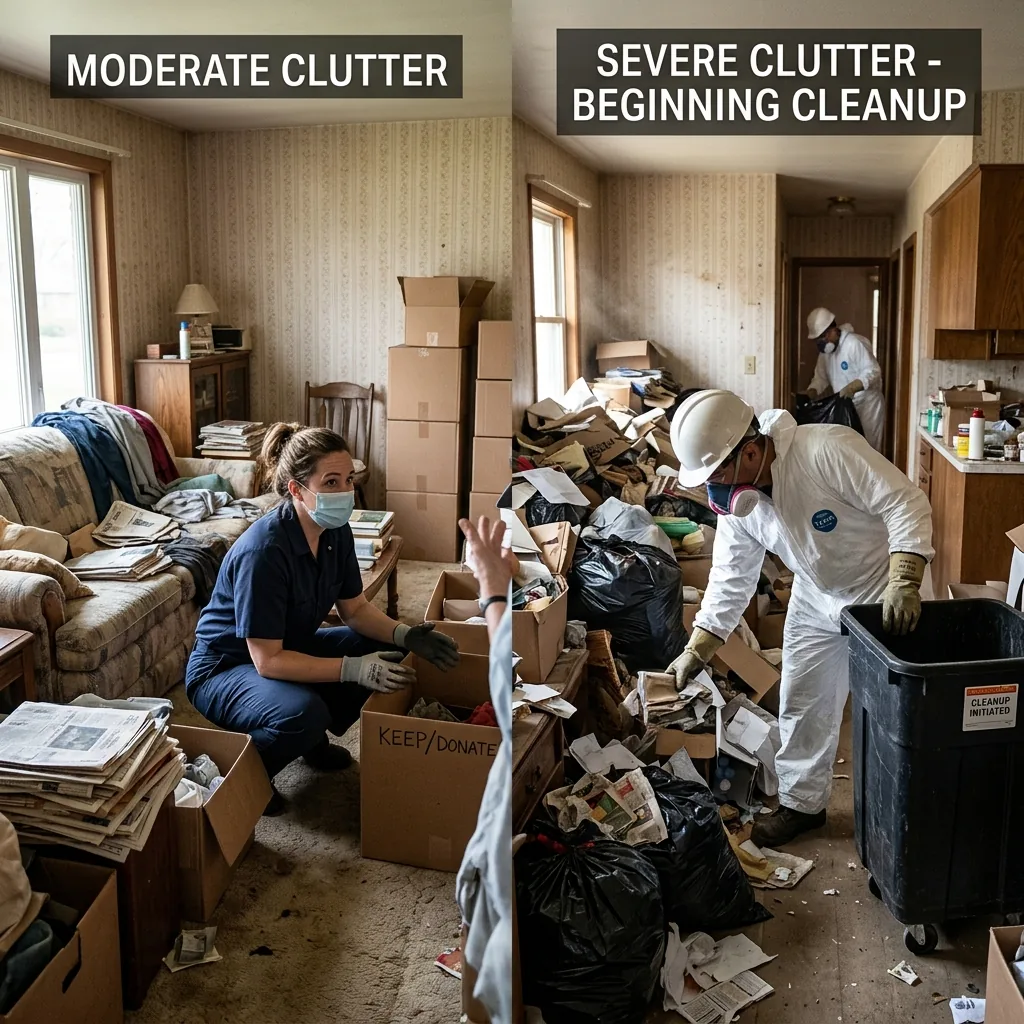
The ICD scale assesses hoarding severity across five dimensions: structural condition of the home, number of animals, cleanliness, sanitation, and access to exits. Each level builds on the previous — Level 5 includes all Level 4 hazards plus additional extreme conditions.
02Levels 1 & 2: Clutter to Moderate Accumulation
The lower levels of the hoarding scale are more commonly encountered and represent situations where the property, while cluttered, does not present immediate safety or biohazard risks.
Level 1 — Light Clutter
Indicators: All doors, windows, and staircases are fully accessible. No odors. No pest activity. All rooms usable for their intended purpose. Minor accumulation in limited areas.
Cleanup approach: Standard organizing and cleaning services are appropriate. No biohazard certification required.
Level 2 — Moderate Accumulation
Indicators: Some pathways partially blocked. One or more major appliances non-functional. Minor odors possible. Limited pet issues (more animals than recommended). Light mold or mildew possible.
Cleanup approach: Professional organizers or experienced deep cleaners may be adequate, but a biohazard assessment is recommended to rule out hidden issues.
03Level 3: The Threshold — When Professionals Become Required
Level 3 is the critical threshold where hoarding transitions from a cleanliness challenge to a genuine biohazard situation. At Level 3, OSHA-certified biohazard remediation professionals become necessary — not optional.
Key indicators that a situation has reached Level 3:
Fort Worth Summer Warning: In DFW's 100°F+ summer heat, what might be Level 2 in a northern state can rapidly escalate to Level 3 biological hazard conditions. Mold growth rates, ammonia off-gassing from animal waste, and pest reproduction all accelerate dramatically in heat. A property that seemed manageable in winter may be a genuine biohazard by summer. Early assessment prevents worse outcomes.
04Levels 4 & 5: Severe and Extreme Emergency Conditions
Level 4 — Severe Biohazard
Indicators: Active sewage backup or overflow. Rotting food throughout the property. Significant structural damage — roof leaks, foundation concerns, walls compromised. Fire hazards from blocked exits. Advanced pest infestation (potentially thousands of rodents or insects). Multiple non-functional utilities.
Action required: Emergency biohazard remediation team. Fort Worth code enforcement notification typically required. Tarrant County APS may need to be involved if a vulnerable adult is present.
Level 5 — Extreme Emergency
Indicators: Property is completely uninhabitable. Possible structural collapse risk from material weight or hidden damage. Biohazardous materials present throughout all areas. Possible undiscovered animal or even human remains. Absolutely no functional utilities.
Action required: Immediate emergency intervention. Tarrant County APS (if vulnerable adult), CPS (if children present), FWPD (if remains discovered), and emergency biohazard remediation simultaneously. Do not enter without certified professionals present.
05Specific Health Risks at Each Hoarding Level
| Level | Primary Biological Hazards | Who Can Perform Cleanup |
|---|---|---|
| 1 | Dust, minor allergens only | Standard cleaning, organizing services |
| 2 | Dust, possible light mold, pet dander | Deep cleaning services; biohazard assessment recommended |
| 3 | Mold spores (respiratory), rodent pathogens (Hantavirus, Leptospirosis), ammonia (respiratory) | OSHA-certified biohazard professionals REQUIRED |
| 4 | All Level 3 plus: sewage pathogens (E. coli, Salmonella, Hepatitis A), advanced decomposition, fire risk | Emergency biohazard team REQUIRED; code enforcement notification |
| 5 | All Level 4 plus: potential human/animal remains, structural collapse risk, maximum pathogen load | Emergency intervention with multiple agencies required |
Never enter a Level 4 or Level 5 property without certified professionals present. Ammonia concentrations from animal waste in enclosed spaces can cause acute respiratory distress in minutes. Mold spore counts at Level 4–5 can cause immediate allergic reactions. Hantavirus from rodent droppings is transmitted by breathing disturbed dust. These are not risks — they are certainties in severe hoarding environments.
06How Professional Hoarding Cleanup Works in Fort Worth
Free On-Site Assessment & Level Determination
Our certified technicians visit the property at no charge. We assess the ICD hoarding level, document specific biohazards present, identify any immediate safety risks, and provide a transparent written estimate before any work is authorized.
Compassionate Item Sorting
Working closely with the property owner or family, we carefully sort all items into keep, donate, and dispose categories. We take this step slowly — understanding that every item carries emotional significance for the person affected by hoarding disorder.
Biohazardous Material Removal & Licensed Disposal
All biohazardous materials — animal waste, mold-saturated items, contaminated food, decomposition residue, pest material — are containerized in DOT-approved biohazard containers and disposed of through Texas TCEQ-licensed medical waste facilities.
Mold Remediation, Deep Cleaning & Odor Elimination
All surfaces are cleaned and treated with EPA-registered disinfectants. Mold-affected areas receive specialized HEPA-vacuum treatment and antimicrobial application. Industrial enzymatic deodorizers and HEPA air scrubbers permanently eliminate all biological odors.
07Hoarding Cleanup Costs by Level in Fort Worth
| Hoarding Level | Fort Worth Average Cost | Typical Timeline |
|---|---|---|
| Level 1–2 (light to moderate) | $500 – $3,000 | 1–2 days |
| Level 3 (biohazard threshold) | $3,000 – $10,000 | 3–7 days |
| Level 4 (severe) | $8,000 – $25,000 | 1–3 weeks |
| Level 5 (extreme/emergency) | $20,000 – $50,000+ | 2–6 weeks |
Insurance may cover Level 3+ hoarding cleanup in Texas. Some homeowner's insurance policies cover hoarding cleanup when linked to a documented medical condition (hoarding disorder is a DSM-5 psychiatric diagnosis). We provide complete documentation for insurance claims. Contact us for a free assessment and insurance eligibility review.
Frequently Asked Questions
Hoarding cleanup questions answered by Fort Worth OSHA-certified professionals
The clearest Level 3+ indicators you can assess yourself: visible mold growth, strong ammonia or decomposition odor, significant pest evidence (droppings, nesting material), major rooms completely inaccessible, non-functional plumbing. If any of these are present, you need certified professionals. Call us for a free assessment — we determine the level at no cost or obligation.
Research shows that forced cleanups without concurrent mental health treatment result in re-hoarding to previous levels within 12 months in most cases. Lasting improvement requires Cognitive Behavioral Therapy (CBT) adapted for hoarding disorder alongside the physical cleanup. We always encourage families to connect their loved one with a hoarding disorder specialist through NAMI Texas: (512) 693-2000.
We work directly with Fort Worth Code Enforcement and can typically complete cleanup within their compliance timelines. We provide written documentation of cleanup completion that satisfies code enforcement requirements. Call us immediately upon receiving a violation — we can often schedule emergency assessment the same day and provide a compliance timeline that satisfies code enforcement while giving the property owner reasonable time to prepare.
The most effective approach is motivational interviewing — ask about their values and goals rather than focusing on the possessions. Express empathy for how difficult discarding is for them. Involve them in every decision about what to keep. Connect them with a mental health professional who specializes in hoarding disorder before, during, and after cleanup. Never attempt forced cleanup without considering whether it violates their legal rights as a property owner.
Need Hoarding Cleanup Help in Fort Worth?
Our compassionate, OSHA-certified team handles all 5 hoarding levels with dignity and respect. We serve all of Fort Worth, Tarrant County, and the DFW Metroplex.