
Quick answer
What to know first
Decomposition odor can persist when affected porous materials or enclosed spaces need professional assessment and treatment, not simply fragrance or surface cleaning.
What to do next: Avoid masking products as a substitute for remediation; first identify whether affected materials require removal or controlled treatment. Explore the related service.
Official guidance: OSHA bloodborne-pathogen standard · EPA disinfectant guidance
Decomposition odors are not a single compound — they are a complex mixture of volatile organic compounds (VOCs) produced by microbial breakdown of organic tissue. The primary odor compounds — putrescine, cadaverine, hydrogen sulfide, ammonia, and methyl mercaptan — penetrate porous materials at a molecular level and cannot be eliminated without professional-grade oxidation technology.
01The Chemistry of Decomposition Odor
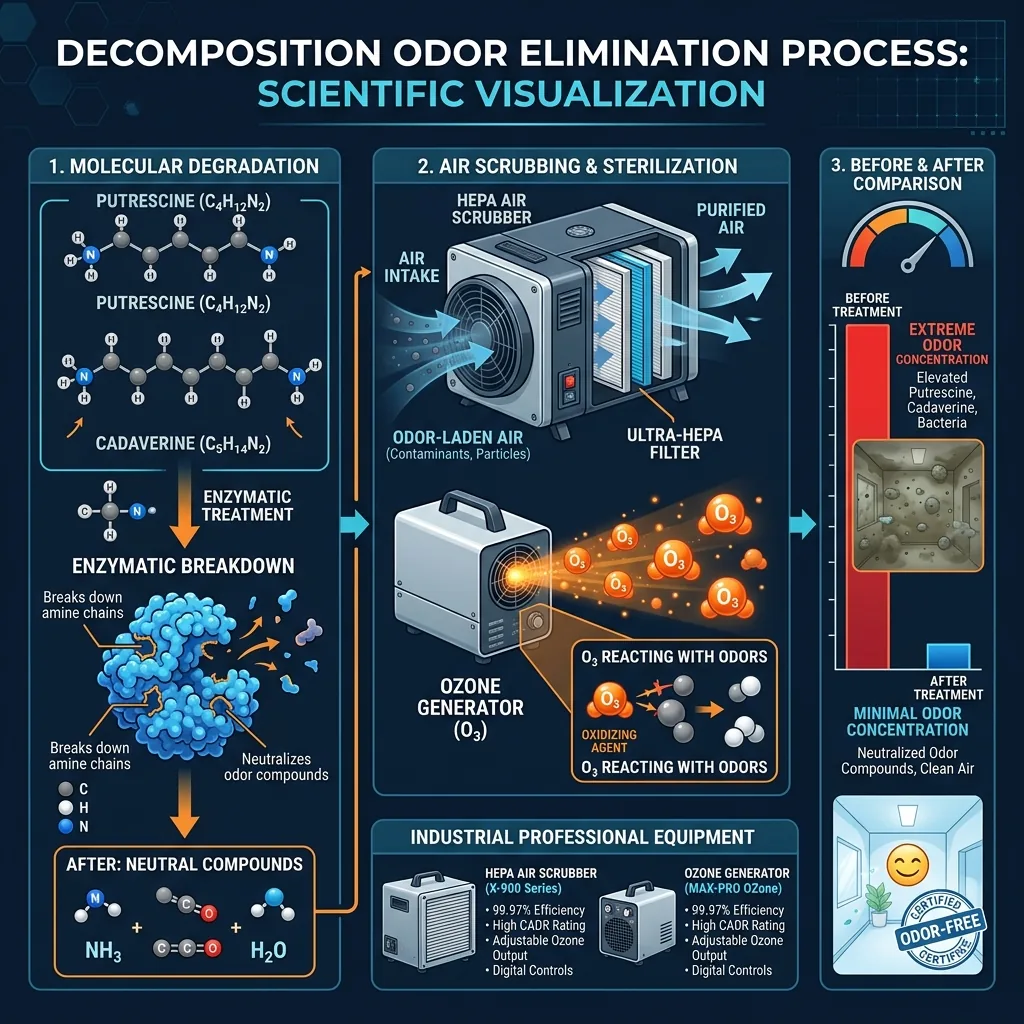
Understanding why decomposition odors are so persistent requires understanding the chemistry behind them. During decomposition, microbial activity produces a specific profile of volatile organic compounds that trigger powerful olfactory responses in humans — an evolutionary adaptation for detecting dangerous contamination.
| Compound | Chemical Name | Odor Description | Penetration Level | Elimination Method |
|---|---|---|---|---|
| Putrescine | 1,4-Diaminobutane | Rotting flesh; sweet-sour decay | Extreme — penetrates concrete | Oxidation + source removal |
| Cadaverine | 1,5-Diaminopentane | Putrid, extremely persistent | Extreme — bonds to porous surfaces | Oxidation + source removal |
| Hydrogen Sulfide | H2S | Rotten eggs; highly acute | High — permeates all materials | Ozone oxidation highly effective |
| Ammonia | NH3 | Sharp, burning, urine-like | High — especially in moist conditions | Enzymatic treatment + ventilation |
| Methyl Mercaptan | CH3SH | Extremely pungent; garlic-like | High — detectable at 1 ppb | Ozone/hydroxyl oxidation |
| Indole/Skatole | C8H7N / C9H9N | Fecal, intensely unpleasant | Moderate — bonds to fabric strongly | Ozone + replacement of porous material |
02Why DIY Odor Products Always Fail
Air Fresheners and Deodorizers
Air fresheners work by masking odors with a stronger scent or temporarily anesthetizing olfactory receptors. They do not chemically neutralize decomposition VOCs. The masking effect lasts hours at most. The underlying compounds remain fully active and continue off-gassing from porous materials indefinitely.
Bleach and Household Cleaners
Bleach (sodium hypochlorite) oxidizes organic matter on hard, non-porous surfaces effectively. It cannot penetrate porous materials (carpet, drywall, wood, concrete) where the bulk of odor compounds are embedded. Additionally, mixing bleach with ammonia-containing decomposition compounds produces toxic chloramine gases.
Baking Soda and Vinegar
Both are mild odor absorbers/neutralizers for simple household odors at pH extremes. Neither has any meaningful effect on putrescine, cadaverine, or the other high-molecular-weight VOCs in decomposition. They are ineffective beyond absorbing surface-level ammonia at very low concentrations.
Ventilation Alone
Opening windows moves air-phase VOCs out of the space temporarily but does not address compounds embedded in porous materials. Within hours, off-gassing from walls, floors, and ductwork re-contaminates the air space. Ventilation is a necessary step in the professional process but is never a complete solution on its own.
03The 5-Stage Professional Odor Elimination Process
Permanent decomposition odor elimination requires a staged approach that addresses the odor source first, then progressively treats the structural and airborne components. Here is the complete protocol our Fort Worth team follows:
Stage 1: Complete Source Material Removal
Before any odor treatment begins, every physical source of decomposition must be removed. This includes all contaminated porous materials — carpet, padding, subflooring, drywall sections, insulation, and any biological material remaining. No odor treatment technology can permanently eliminate odors while the biological source remains in place. Source removal is the non-negotiable foundation of successful odor elimination.
Stage 2: Enzymatic and Chemical Neutralization
EPA-registered enzymatic cleaners are applied to all structural surfaces that contacted decomposition fluids. Enzymes break down protein-based compounds (including putrescine and cadaverine precursors) at a molecular level, eliminating the compounds rather than masking them. Products are applied with documented dwell times of 15–30 minutes minimum. Specialized chemical neutralizers are applied to concrete and subfloor surfaces after enzymatic treatment.
Stage 3: Ozone Shock Treatment
Industrial ozone generators (producing 20,000–50,000 mg/hour of O3) are placed throughout the affected area with all HVAC vents open. Ozone (O3) is an extremely reactive oxidizing agent that breaks the molecular bonds of VOCs on contact, chemically destroying odor compounds rather than masking them. The space must be fully evacuated during ozone treatment — ozone concentrations above 0.1 ppm are hazardous. Treatment runs for 4–24 hours depending on severity. After treatment, off-gassing time (4–8 hours with ventilation) is required before re-entry.
Stage 4: Hydroxyl Radical Generation
For situations where ozone cannot safely treat (occupied structures, electronics present, certain materials), hydroxyl generators using UV-C light photocatalysis produce hydroxyl radicals (OH) that react with and destroy VOCs. Hydroxyl treatment is safe for occupied spaces and works continuously. It is less aggressive than ozone for extreme cases but highly effective for residual odors after ozone treatment and for ongoing air quality maintenance.
Stage 5: Thermal Fogging and Final Verification
Thermal foggers use heat to vaporize specialized odor-neutralizing solutions into an ultra-fine aerosol that penetrates the same pores and cavities that odor compounds have entered. The fog reaches areas that sprayed liquids cannot — inside wall cavities, under flooring edges, into ductwork. After fogging and ventilation, final odor verification testing confirms complete elimination before we issue our odor clearance documentation.
04Ozone Treatment: The Science and the Safety
Ozone is the most powerful commercially available oxidizing agent for odor elimination. It destroys VOCs through oxidation — the same process that breaks down organic molecules. However, it requires specific safety protocols:
05Hydroxyl Generator Treatment
Hydroxyl generators represent the next generation of odor elimination technology. They use UV-C light photocatalysis combined with titanium dioxide catalysts to produce hydroxyl radicals (OH) — the same compounds the atmosphere uses to naturally break down pollutants. Advantages over ozone:
06HVAC System Decontamination: The Most Overlooked Step
The most common reason odors return after treatment: HVAC systems were not decontaminated. Decomposition VOCs enter ductwork, coat the evaporator coil, and contaminate air handler insulation. Every time the HVAC system runs, it re-distributes odors throughout the structure. HVAC decontamination is non-negotiable for permanent odor elimination.
Our HVAC decontamination protocol for decomposition situations includes:
07Fort Worth Heat: Odor Amplifier
Fort Worth's summer temperatures above 100°F dramatically affect both the severity and treatment timeline for decomposition odors:
Decomposition Odor Elimination — Fort Worth
5-stage professional process. Permanent odor elimination guaranteed. HVAC decontamination included.
Frequently Asked Questions
Decomposition odor elimination questions answered by Fort Worth professionals
Decomposition odors are caused by volatile organic compounds — putrescine, cadaverine, hydrogen sulfide, ammonia, and methyl mercaptan — that penetrate porous materials at a molecular level. Air fresheners mask odors temporarily. Bleach oxidizes organic matter on hard surfaces only but cannot penetrate porous materials where odor compounds are embedded. Permanent elimination requires physical source removal followed by enzymatic treatment, ozone/hydroxyl oxidation, and HVAC decontamination — the complete 5-stage professional protocol.
Standard situations (discovery within 1 week): 2–4 days. Advanced cases with wall/ductwork penetration: 5–10+ days. The process includes source removal (1–2 days), enzymatic treatment (same-day), ozone treatment (4–24 hours), post-ozone ventilation (4–8 hours), hydroxyl treatment (24–48 hours), and HVAC decontamination. Fort Worth summer heat adds 20–40% to treatment timelines due to deeper penetration and higher re-emission rates.
Ozone is highly effective at oxidizing decomposition VOCs — but only after the biological source has been physically removed. Ozone used as a standalone treatment without source removal will temporarily reduce odor but the source continues producing new VOCs. As Stage 3 of our 5-stage protocol (after source removal and enzymatic treatment), ozone achieves 90–95% odor reduction. Combined with Stage 4 (hydroxyl) and Stage 5 (thermal fogging + HVAC decontamination), permanent elimination is achieved.